(about a 5.5-minute read)“He who has great power should use it lightly."
[Seneca]
Welcome back to Spiegelbild!
In an ideal world, relationships are created on a foundation of mutual respect and trust — an openness and curiosity from all parties involved to enter and be in a relationship. There is a balance. And a freedom to choose.
The balance of power
Recently I was invited to give a keynote speech.
The afternoon light is flowing into the room through large windows. The initial buzz in the room quiets down quickly as I’m talking, and I feel a welcoming and attentive energy from the audience. I have finished my initial talk and we are about 20 minutes into the Q&A session when one participant asks: “There is a power-imbalance between horse and human, with horses being prey and humans being predators. How do you reconcile this in your work?”
At first, I am surprised.
While I have thought about this many times, it’s the first time that someone has asked me this question in a room full of people.
And then I feel a deep appreciation. Because this is the kind of curiosity that is foundational to my work, and opens up different angles about the dynamics of power, and how fragile the balance is.
A partnership of equals
I want to change what we understand leadership to be.
I have witnessed — and experienced — the heavy toll an indiscriminate command-and -control way of leading takes on people, when, instead of genuinely caring and lifting people up, a person only asserts power over others. It suffocates creativity, kills ideas, and extinguishes the spark in a person. And while things are shifting away from this style of leading, it still is prevalent out there.
To foster change I invite clients of my programs to engage in a coaching relationship with an unlikely partner — a horse. The novelty of this approach is not solely about involving an animal to teach interpersonal and leadership skills (that too, but that is a story for another time). Rather, it is about how my clients are invited to engage in this coaching relationship.
There is much for us to learn from our non-human relatives. But that learning requires something from us first: a willingness to enter into relationships without judging. Without comparing from a human-centric standpoint. And without assuming we are the smartest person in the room.
This is why I create a level playing field, where human and horse meet on equal terms.
The extension of trust
Horses are large animals. A typical horse weighs about 1200 pounds, has keen instincts and lightning-fast reactions. A horse is also quite strong and powerful. So, one might think that the horse obviously has a physical advantage over the human.
I would like to argue, however, that none of these physical differences truly matter when a relationship is entered into with a willingness to trust, mutually respecting one another, and seeking to find a common language that allows one to establish clear communication and understanding.
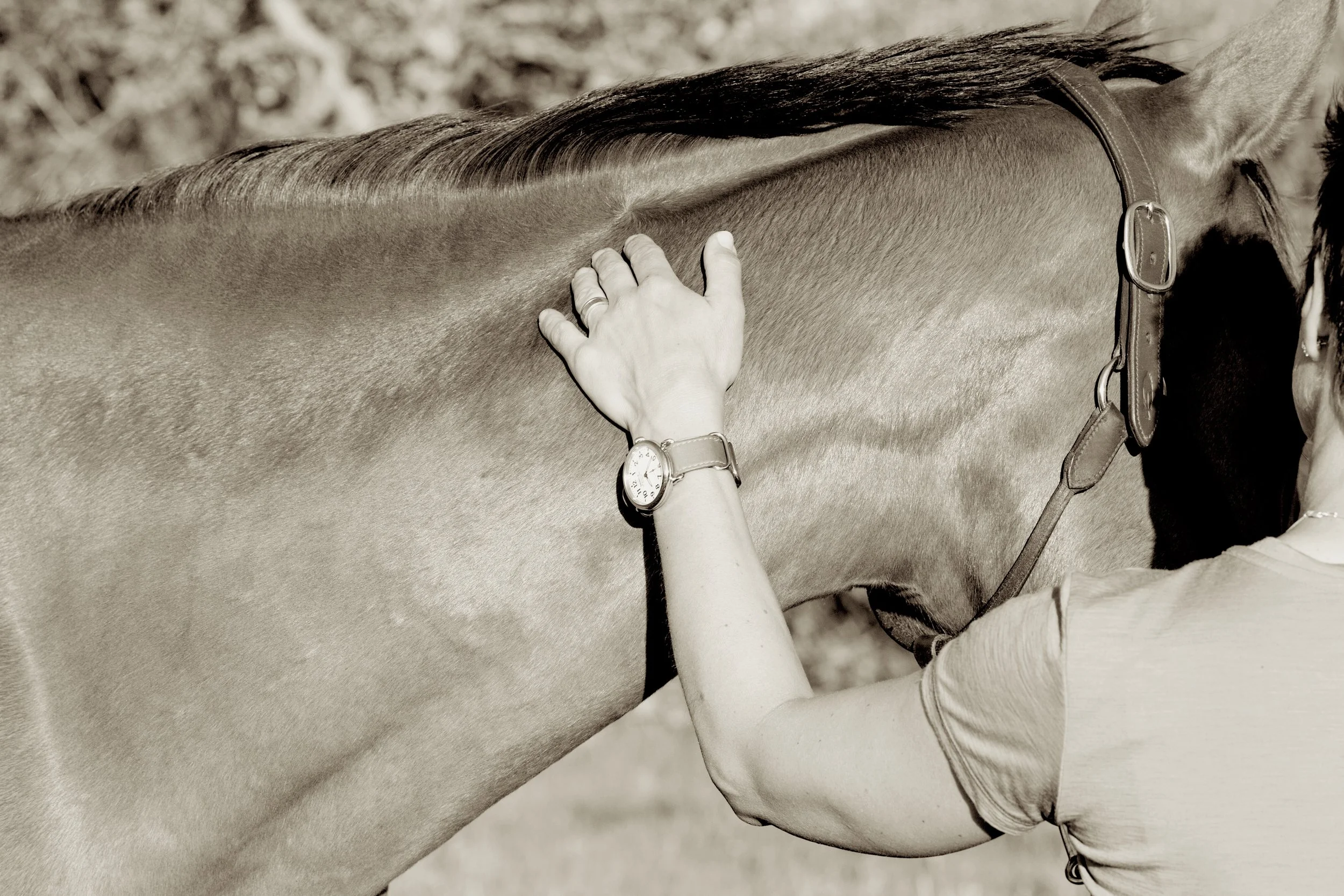
The usual set up for working with a horse is to use a halter and a lead rope. However, these tools can be used to create leverage with which the human can dominate or control the animal. My programs seek to offer a different way. They are about developing interpersonal and leadership skills — experienced through the biofeedback, relational presence, and honest mirroring offered by a horse. That is why I only equip my horses with a neck rope, which allows the horse freedom of choice and expression.
A level playing field only works if both parties choose to show up for it.
I have often wondered why horses, who are prey animals, are so open and generous when engaging with us, given we are predators (our forward-facing eyes are a dead giveaway). Wouldn’t it be natural for them to be sceptical and mistrusting towards us?
Horses are highly social animals that prefer to live in stable social groups. With domestication their desire to form social bonds was extended to us humans.
Horses have a special sensitivity and cautious curiosity when it comes to connecting with people. Entering into a relationship with a horse thus requires something different of us — it asks the human to meet them part of the way.
This “meeting part of the way” also extends to how long-term positive relationships are formed. Research is starting to show that a good relationship between horse and human requires freedom to choose — for both partners. A positive relationship is not possible when horses are forced to be with people. A horse that chooses to stay is choosing something. That choice is the relationship.
These same foundational building blocks — the desire to form social bonds, extending curiosity, meeting the other half-way, and the freedom to chose — also are essential to creating positive, lasting relationships between humans.
So, if a relationship starts out on a level playing field, what tips the balance?
The tilt
The tilt starts to happen when one party abandons the mutual field and reaches for tools to “control”. In the horse world these tools might look like spurs, whips, or bits. In leadership they can show up as a sharp tone, reminding others of one’s title, or intentionally making a decision without consultation.
Any tool can be used in a gentle, guiding way, or in a harmful, pain-inflicting way. It’s therefore often not the tool itself, or the use of a tool that creates a problem. It’s the intention behind the use.
By the time a power imbalance is established it can be quite visibly obvious.
However, this state is usually preceded by more subtle or invisible changes. Maybe communication between people stalled or became superficial. One party lost interest, defaulted to judgement, couldn’t find the energy to stay curious. Cracks started to show in the trust between people. Emotions began to create barriers. And instead of investigating the information that was transmitted by these emotions, people simply reacted to them.
Whatever the tool that’s being used, the underlying principle stays the same. It’s the intention of “forcing” or “making someone do something”, the mindset of “do as I say or else… ” that prevents meeting eye to eye — on equal terms.
Power imbalance rarely announces itself. It looks like a shorter reply than usual. A door closed a little faster. A question not asked.
Resisting the temptation
I have been reflecting on this question of power imbalance since the keynote speech. And particularly about how often we unintentionally create imbalances as leaders. What tends to get in our way? Why do we reach for a tool? What do we want to signal — and what are we actually signalling?
I believe that any learning starts with self-reflection. And that is where the difference lies between using a tool and the intention behind its use. Grabbing a tool to achieve something is an action on the “outside”. The intention behind the use of a tool, however, happens on the “inside”. It is where the connection to subconscious behaviour patterns, self-beliefs and emotions lives.
Understanding these patterns and behaviours requires people to pause, reflect and make conscious choices about why and how they want to use a tool, rather than reaching for the nearest one.
This is where horses have a lot to teach us. They have the talent to surface behavioural patterns we are not necessarily aware of. A horse reads our energy before we have acted. It detects the tilt in our intention before we know we have made it. A horse doesn't ask what tools we are carrying. It only asks what we intend to do with them. Halters are not the key to the relationship.
Maybe the question worth sitting with is this: when you step into a relationship — with a colleague, a team, a person you love — do you know which tools you're reaching for? And do you know why?